 Official U.S. shop
The basics
How Does NeuroDyne Work? Three Herbs in One Dropper
NeuroDyne delivers three herbs studied for memory and attention in one daily dropper.
The herbs are ginkgo, bacopa and lion's mane. Each herb's own research is the best guide to what they may do (FTC, Health claims).
See the ingredients.
Written by the NeuroDyne editorial teamUpdated
The idea
How is NeuroDyne supposed to work?
Margaret, 68, sets the amber bottle beside her pill organizer and turns it slowly in her hand. She is looking for the back panel, the part that says how much of each herb is inside.
The plan behind NeuroDyne is simple. Three plants and mushrooms that researchers have tested for memory and attention go into one liquid. You take the amount printed on your bottle each day. The bottle front promises better focus, sharper memory recall and more mental energy.
What the plan rests on is the research on each herb taken alone. Nobody has tested the NeuroDyne formula in people. The Federal Trade Commission says health claims generally need human trials of the product or an equivalent formula (FTC, Health claims). So the fair way to explain how it works is herb by herb, with the limits in plain view.
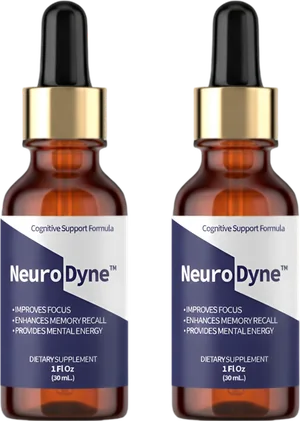
Like Margaret, you will not find that back panel in any photo or on the sales page (checked October 11, 2026). Our label and facts page types out what the front says.
Inside the dropper
What is actually in the dropper?
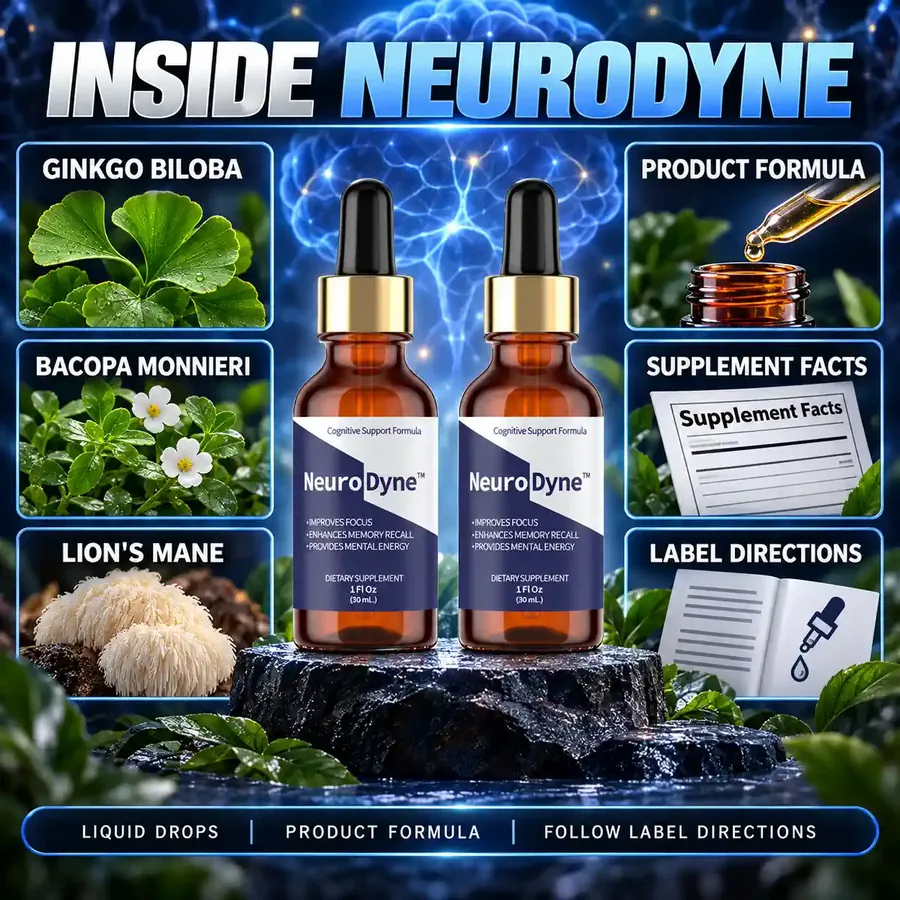
The sales FAQ and the brand's "Inside NeuroDyne" graphic name three ingredients. No amounts are given, and no other ingredient is listed. We cannot tell whether the liquid base is alcohol or glycerin, because the Supplement Facts panel is not shown anywhere we looked.
Bacopa monnieri
An Ayurvedic herb with the most trials of the three.
Lion's mane
A shaggy white mushroom with small, mixed human studies.
Herb by herb
What did each herb do when researchers tested it?
Each line below comes from studies of one herb alone, usually in capsules or tablets.
| Herb | Amount in NeuroDyne | Study dose and length | What the studies found |
|---|---|---|---|
| Bacopa | Not published | 300-450 mg a day of extract, 12 weeks or more (StatPearls, Bacopa) | Across 9 trials and 518 people, small gains in speed of attention (Kongkeaw et al., 2014) |
| Ginkgo | Not published | 120 mg twice daily, median 6.1 years, 3,069 adults aged 75+ (DeKosky et al., 2008) | Did not prevent dementia: 17.9% on ginkgo vs 16.1% on placebo (GEM trial results, 2008) |
| Lion's mane | Not published | About 3 g a day for 16 weeks in 30 adults with mild memory problems (Mori et al., 2009) | Scores rose, then fell 4 weeks after people stopped |
| Lion's mane | Not published | 1.8 g a day for 28 days in 41 healthy young adults (Docherty et al., 2023) | Most measures showed no change |
The pattern: bacopa needed about three months for a small effect. Ginkgo's largest trial was a clear no on dementia. Lion's mane is early science.
Evidence ladder
How strong is the evidence at each rung?
The longer the bar, the more directly that evidence speaks to your own bottle.
- Bacopa9 trials, 12+ weeks
Small gains in attention speed at 300-450 mg a day. (Kongkeaw et al., 2014)
- Lion's maneSmall trials, 30-49 people
Mixed results; gains faded after stopping in one trial. (LiverTox, Lion's mane)
- GinkgoGEM trial, 3,069 adults
Did not prevent memory decline or dementia over about 6 years. (DeKosky et al., 2008)
- NeuroDyneNo study of the product
No trial of NeuroDyne, and no published amounts to compare. (FTC, Health claims)
Bar length shows how directly each line of evidence answers the question: will this bottle help my memory or focus? It is our editorial summary of the linked sources, not a score from any study.
The brand graphic
What does the brand's "How NeuroDyne Works" graphic tell you?
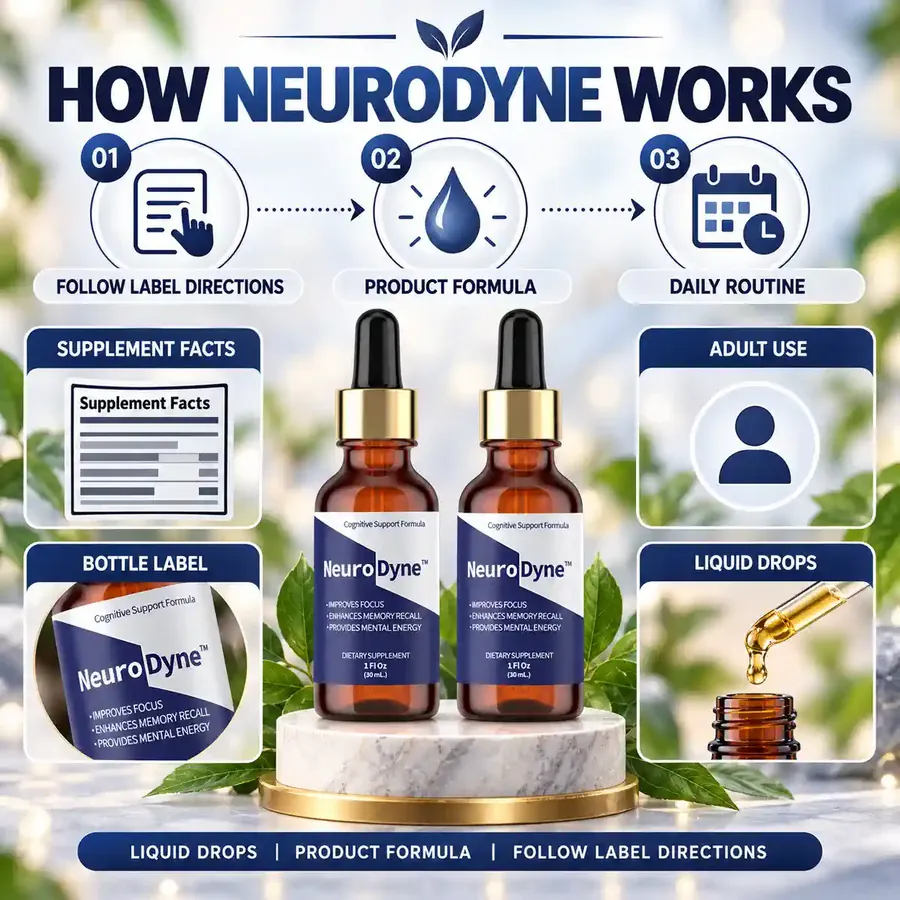
The graphic shows three tiles: 01 Follow label directions, 02 Product formula, 03 Daily routine. It reads like a promise of a method. In practice it says one useful thing: the directions live on your bottle.
It shows no dose, drop count or time of day. Read it as packaging art, not as instructions.
What to check against the graphic
- Find the dropper amount on your own bottle before the first use.
- Look for a Supplement Facts panel with milligrams for each herb.
- Look for printed warnings and storage directions.
- If any of those are missing, write to the maker before you start.
Try NeuroDyne inside the 60-day window1 fl oz dropper bottle · from $49 a bottle on 6 · free U.S. shipping on 3 or 6
Order nowLiquid form
Do liquid drops work differently from capsules?
Nobody has published a comparison for NeuroDyne, so there is no evidence that drops work better or faster. The sales page does not give an absorption figure either.
The form does matter in one practical way. Every study in the table used capsules or tablets of a single herb. One 1 fl oz (30 mL) bottle has to last about 30 days, per the sales FAQ. That leaves roughly one milliliter of liquid per day for all three herbs and the base.
The bacopa trials used 300 mg or more of dry extract a day. Lion's mane trials used 1 to 3 grams. A small daily volume may hold far less than those amounts. We cannot say how much less, because the amounts are not published.
Before the first dropper
What should you ask your pharmacist before you start?
Picture a 71-year-old retired teacher who takes a baby aspirin every morning. She brings the NeuroDyne bottle to the pharmacy counter and asks one question: does any of this thin the blood?
That is exactly the right question. Ginkgo may raise bleeding risk with blood thinners such as warfarin, and its common side effects include dizziness, stomach upset and headache (NCCIH, Ginkgo).
Questions to take to the counter
- Do any of my medicines interact with ginkgo, bacopa or lion's mane?
- I take seizure, diabetes, mood or memory medicine. Should I avoid adding an herb?
- I have surgery or a dental procedure coming up. When should I stop?
- Is there a reason my memory symptoms need a check before I try a supplement?
Talk to your doctor or pharmacist before taking any ginkgo product. Mention it again before any planned surgery.
Our who it's for guide lists other reasons to ask first.
Honest limits
What can a memory supplement not do?
It cannot diagnose or treat dementia, Alzheimer's disease or ADHD. NeuroDyne is a dietary supplement, not a drug, and the FDA does not approve supplements before they are sold (FDA, Using supplements).
It also cannot fix the common, treatable reasons for slipping memory. MedlinePlus lists low vitamin B12, side effects of medicines, alcohol, depression and stroke (MedlinePlus, Memory loss). Metformin and acid reducers can lower B12 over time (NIH ODS, Vitamin B12). NCCIH advises against using any supplement as a reason to put off a visit about memory loss (NCCIH, 7 things).
NeuroDyne bundles three herbs with real but modest research behind them. Treat it as an experiment you track, alongside sleep, movement and regular checkups.
In short
So how does NeuroDyne work, in plain terms?
It aims to give you a daily taste of three well-known herbs in one easy liquid. Bacopa has the strongest hint of a benefit, after about 12 weeks. Ginkgo and lion's mane have weaker or mixed records. The product itself has no trial, and its amounts are unpublished.
If you try it, read your bottle first, clear it with your pharmacist, and keep notes through the 60-day money-back window. Our how to use page shows a simple daily routine.
FAQ
How NeuroDyne works: common questions
How does NeuroDyne work in the brain?
No one has studied how NeuroDyne itself acts in the brain. The idea rests on its three named herbs. Bacopa showed small gains in attention speed after 12 or more weeks, ginkgo did not prevent dementia in a large trial, and lion's mane trials were small and mixed (Kongkeaw et al., 2014) (DeKosky et al., 2008).
What are the three ingredients in NeuroDyne drops?
The sales FAQ names ginkgo biloba, Bacopa monnieri and lion's mane mushroom. No amounts are published, and no other ingredient is listed. We could not see a Supplement Facts panel, so the liquid base and any added ingredients are unknown. Ask the maker before you buy if that matters to you.
Is NeuroDyne a stimulant?
No. None of the three named ingredients is a stimulant, and no caffeine is listed. The bottle says it provides mental energy, but that is a marketing claim. If you want a quick lift, coffee works differently; healthy adults can have up to 400 mg of caffeine a day (FDA, Caffeine).
Has NeuroDyne been tested in a clinical trial?
No study of NeuroDyne has been published. The research belongs to each ingredient taken alone, at doses we cannot compare because the bottle's amounts are not shown. The FTC says health claims generally need trials of the product or an equivalent formula (FTC, Health claims).
How much bacopa is in one dropper of NeuroDyne?
That amount is not published on the sales page or in any bottle image we have. Bacopa trials used 300 to 450 mg of extract a day for at least 12 weeks (StatPearls, Bacopa). Write to the maker at the sales email and ask for the milligrams per serving before you decide.
Can a pharmacist tell me if NeuroDyne is safe for me?
A pharmacist can check the three named herbs against your medicines, which is the most useful step you can take. Bring the bottle and a list of everything you take. Mention blood thinners, aspirin, seizure, diabetes or mood medicine, and any planned surgery.
Who wrote this
Written and reviewed by
Plain-language pages built from the bottle images, the sales page and linked public health sources such as NIH, FDA and Cochrane.
Last updated . Read our editorial standards and how we check reviews. This website is run by Neuro-dyne, a USA authorized NeuroDyne retailer, not by the manufacturer. We earn money when you buy through our order links.
Keep reading
More about NeuroDyne
Ingredients
Ginkgo, bacopa and lion's mane are named, but no amounts are. What each herb did in studies.
Read more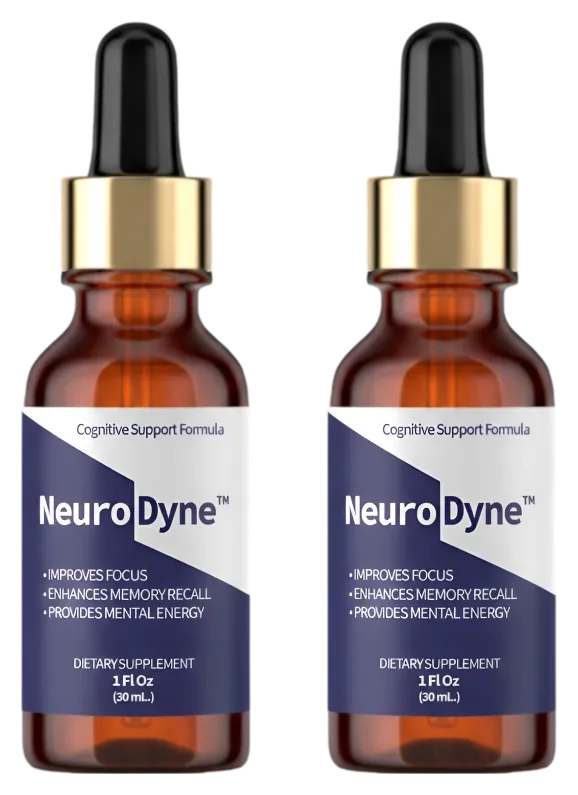
Supplement facts
The NeuroDyne label typed out word for word, plus the panel details that are still not published.
Read moreDosage
No serving size is published for NeuroDyne. What to read on the bottle and ask before the first dropper.
Read moreUSA Authorized NeuroDyne Retailer
Ready to try NeuroDyne?
Pick a pack. Read your bottle's directions first; every pack lasts long enough to use the 60-day window.
- Secure checkout
- 60-day money-back window
- Tracking in the order email